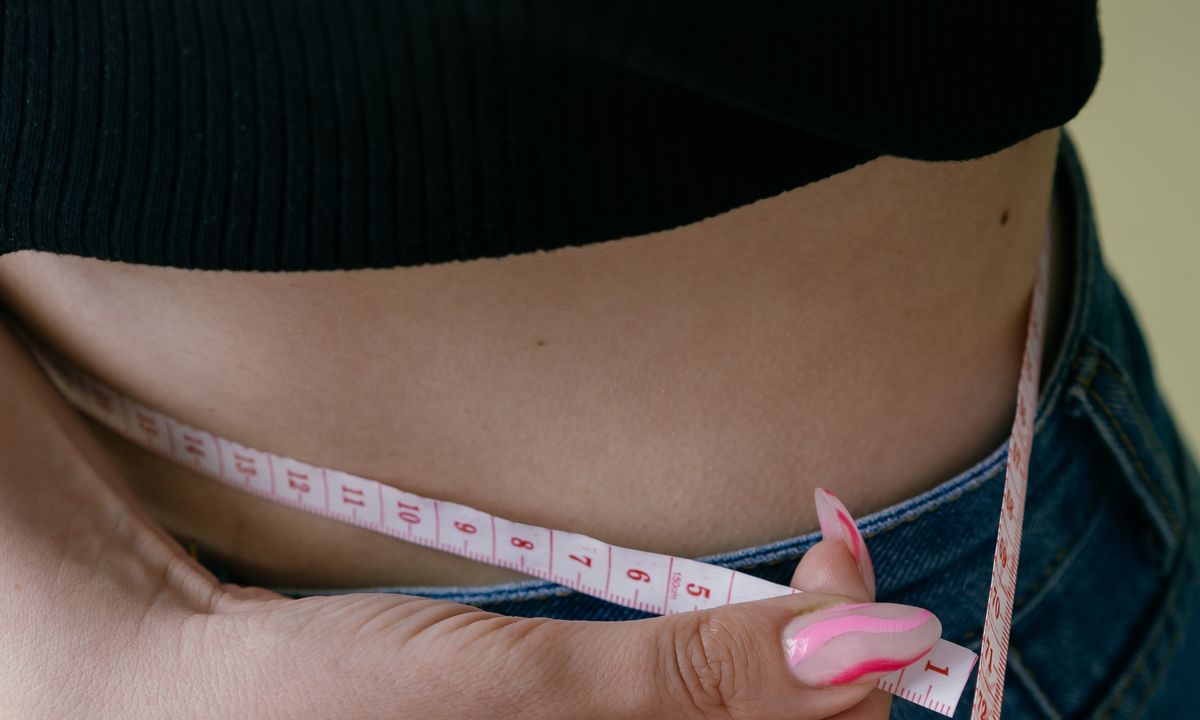
Many women reach perimenopause and notice something odd: even when the scale barely moves, their shape changes. Weight that once settled on the hips and thighs starts collecting around the middle. This isn't a failure of willpower or a sign you've suddenly started eating differently. It's a documented, hormone-driven shift in where your body stores fat.
Estrogen decides where fat goes
Through the reproductive years, estrogen encourages fat storage in the hips, thighs, and buttocks — the classic "pear" distribution. As estrogen declines in perimenopause, that pattern reverses: fat storage migrates toward the abdomen, and specifically toward visceral fat — the deeper fat packed around your internal organs, rather than the softer fat just under the skin.41
The numbers are striking
This is measurable, not just a feeling. In the SWAN Fat Patterning Study, postmenopausal women carried substantially more visceral fat than women who were still menstruating — a gap that remained significant even after accounting for age.2 And the accumulation clusters around the transition itself: visceral fat climbed roughly 25% in the years leading into the final period, then leveled off in the first year or two afterward.3
Why the shift happens
- The estrogen-to-androgen balance changes. As estrogen and sex-hormone-binding globulin fall, more bioavailable testosterone circulates — and higher bioavailable testosterone is a strong, independent predictor of visceral fat.2
- Fat storage location is hormonally programmed. The same fat cells behave differently as the hormonal signals around them change.
- It's layered on top of normal aging, which we'll unpack in the next article.
Why it matters beyond appearance
Visceral fat isn't only a wardrobe frustration — it's the metabolically active kind. It's associated with a higher risk of insulin resistance, cardiovascular disease, and type 2 diabetes.4 That's exactly why this matters enough to understand and act on, and it connects directly to the heart-health series in this library.
The reassuring flip side: because the change is driven by identifiable mechanisms, it responds to targeted strategies — the subject of the final article in this series.
This article is for general information and is not medical advice. Talk with a qualified clinician about weight, metabolic health, and any personal risk factors.
References
- Why am I gaining belly fat during menopause? — Harvard Health Publishing.
- Testosterone and Visceral Fat in Midlife Women: The SWAN Fat Patterning Study (PMC2866448).
- Increased visceral fat and decreased energy expenditure during the menopausal transition (PMC2748330).
- The Connection Between Menopause & Belly Fat — University Hospitals.
PeriShift starts with a 30-day free trial on Android and iPhone. No account. No cloud. Your logs stay on your phone.
Get PeriShift on Google Play → Get PeriShift on the App Store →